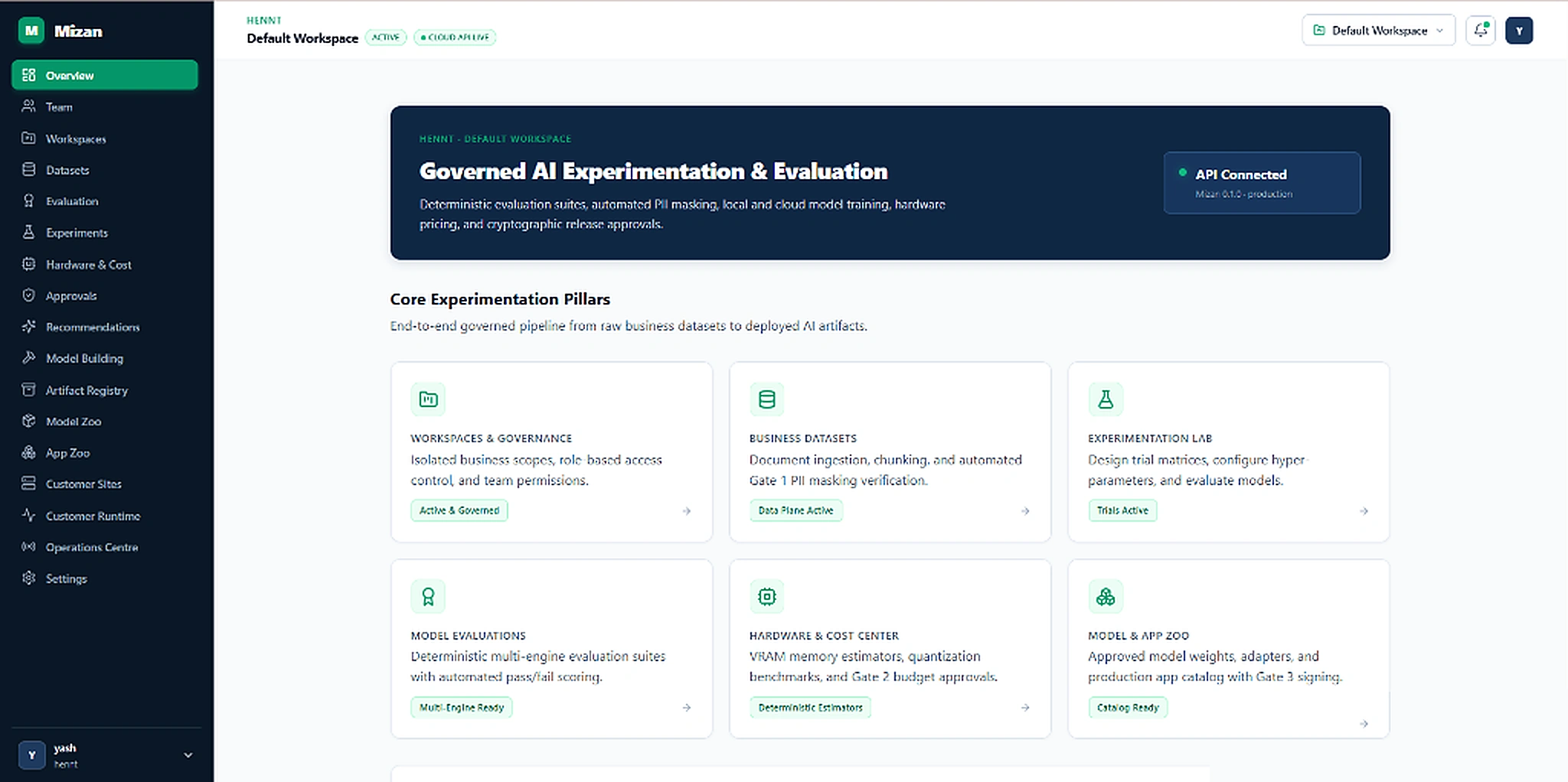
Executive Overview: What is MIZAN?
MIZAN (mizan.hennt.in) is HENNT's proprietary Enterprise AI Lifecycle and Model Operations platform. It unifies raw dataset governance, continuous experimentation, automated Gates 1–3 model validation, zero-egress offline RAG, and sub-second rollback recovery into one resilient operational backbone.
The Enterprise Dilemma: Why AI Pilots Fail in Production
In 2026, enterprise CTOs and CIOs face a familiar frustration: data science teams produce impressive proof-of-concept Jupyter notebooks, but when those models are plugged into live ERPs, hospital electronic records, or financial pipelines, they collapse.
They collapse because of operational entropy: undocumented prompt regressions, silent data drift, lack of deterministic audit trails, unpredictable API latencies, and serious data privacy risks from piping sensitive records through public cloud endpoints.
At HENNT, we designed MIZAN to treat AI as mission-critical systems engineering. MIZAN provides the missing operational scaffolding that allows regulated enterprises to deploy generative AI with the same predictability, compliance, and uptime guarantees as a banking database.
The Five Architectural Pillars of MIZAN
| Subsystem | Core Function | Engineering Mechanism |
|---|---|---|
| 1. Dataset Governance & Lineage | Guarantees exact traceability of training & fine-tuning data | Cryptographic SHA-256 content hashing, PII redaction filters, and immutable audit logs |
| 2. Gates 1–3 Validation Pipeline | Automated stage-gate hurdles before model deployment | Automated schema syntax checks (Gate 1), semantic benchmark evaluation (Gate 2), stress testing (Gate 3) |
| 3. Sovereign Zero-Egress RAG | Air-gapped semantic search with zero network leakage | Local quantized embedding models, on-premise vector indices (Milvus/FAISS), offline reasoning |
| 4. Unified Model Registry | Single source of truth for checkpoints, prompts, and weights | Semantic versioning, metadata manifests, and rollback pointer snapshots |
| 5. Telemetry & Sub-Second Rollback | Continuous monitoring and automated circuit breakers | Real-time drift telemetry, perplexity tracking, and sub-500ms automated failover |
Deep Dive: The Control Plane & Runtime Isolation
MIZAN is engineered around a strict separation between the Control Plane and the Execution Runtimes:
- The Control Plane (mizan.hennt.in): Manages model state machines, access controls, audit logs, and validation runs. It is completely decoupled from customer data payloads, ensuring zero administrative snooping.
- Air-Gapped Sovereign Runtimes: Deployed inside customer VPCs or on-premise Kubernetes clusters. Document embeddings, customer contracts, and patient histories are indexed and queried strictly within the enterprise perimeter. Data never leaves the enclave.
Automated Gates 1–3: The Quality Filter
No model, prompt revision, or fine-tuned weight set can reach production in MIZAN without passing through three automated quality gates:
- Gate 1 (Integrity & Syntax): Verifies JSON schema validity, token budget constraints, deterministic temperature settings, and absence of raw credentials.
- Gate 2 (Semantic Benchmark & Accuracy): Runs automated regression tests against thousands of golden enterprise test cases, bounding hallucination metrics below pre-configured thresholds.
- Gate 3 (Production Enclave Stress): Simulates concurrency bursts, enforces P99 latency bounds under 800ms, and subjects the model to automated red-teaming for prompt injections.
Explore MIZAN Live & Architectural Specs
Read the complete technical specification at mizan.html or access the active enterprise control plane at mizan.hennt.in ↗.
Frequently Asked Questions
Can MIZAN work with open-source models like Llama 3, Mistral, and DeepSeek?
Yes. MIZAN is completely model-agnostic. It supports self-hosted open-weights models (via vLLM, Ollama, or Hugging Face TGI) as well as commercial enterprise API providers.
How does MIZAN ensure compliance with Indian DPDP Act and HIPAA?
Through zero-egress architecture, automated PII masking at ingestion, cryptographic access logging, and strict data residency controls that keep all vector stores inside domestic sovereign infrastructure.